Why you keep paying for free games
Originally published on LinkedIn
You've just swiped and tapped your way through the game you've been playing for the last while. Unfortunately, you've run out of plays for the hour, but a brightly coloured screen pops up telling you that for the sum of $0.99, you can play as much as you want for the next hour.
It's less than a dollar -- so you tap, pay and play for the next hour peacefully with no interruptions.
Welcome to the world of microtransactions.
Microtransactions, or in-app purchases (IAP) as they're sometimes called, can trace their origin back to classic arcade machines. Pop in a few coins and play until you run out of time or lives. In recent times, mobile gaming has truly made microtransactions ubiquitous. The structure of Google's Play Store and Apple's App Store allowed developers to sell free games and add in-app purchases to make money -- a 'freemium' game.
In 2014, it was reported that freemium apps make up 98% of worldwide Google Play revenue.
Why do microtransactions work though? Here are two principles that contribute to their success.
#1 -- The Endowment Effect
Simply put -- an individual may value a good higher if it becomes part of their endowment; that is, we value things we own higher than if we didn't own them.
Tested by Daniel Kahneman in a study in 1990, this was experimented upon by having two groups of participants. One group was "potential buyers" and one was "potential sellers." Both were given the same object and asked to value it. The sellers group valued the object higher than the buyers group.
To put it into the context of your mobile apps: if you were to download a free game which offered IAPs and spent x hours playing it, the game would be yours. Due to the dedicated time, the feeling of ownership would grow. Due to the endowment effect you would start to value the game higher, and since the product was free to start with, you would be likely to spend y amount of money on the game until the money spent feels like it justifies the game's now-higher value.
Free to play works because it doesn't ask you to value the game until you already feel you own it.
I do this for the love of writing — each subscriber costs me money. But please subscribe anyway and spread the word.
#2 -- Ego Depletion
A particularly interesting phenomenon studied by Dr. Roy Baumeister et al. in 1998 had participants exert self-control by being placed in a room with a one-way mirror and told to eat raw radishes instead of "delicious chocolate chip cookies." Although no one actually bit into a cookie, people got visibly distracted by them and longed to eat them. Afterwards, the participants had to engage in a series of problem-solving games, with their mental reserves sapped by self-restraint. Compared to a control group that was allowed to eat the cookies, the radish group gave up and quit the puzzles in less than half the time. Similar experiments followed where participants had to suppress smiles while watching comedy, and then see how long they would persist in a word puzzle game. Findings were similar, with the "mental reserves sapped" group giving up on puzzles earlier. (Madigan, 2012)
This theory very clearly shows why people would spend money on free-to-play games. Boring, monotonous tasks -- repeating the same activity over and over again, waiting for a timer to go down, watching your character walk slowly through the game world -- are all chore-like activities designed to bore the user. Having to do them repeatedly makes us more likely to simply purchase the boost or the helper instead of patiently waiting.
Ego depletion brought about by exerting self-control can make us more susceptible to making impulse purchases.
In the context of gaming -- when we are faced with another 20-minute countdown timer to advance, we might as well pay that one dollar to speed it up.
Food for thought
Ego depletion and the endowment effect both work extremely well when free-to-play games have multiplayer components, especially leaderboards. These leaderboards are always easily accessible and show the current player's ranking out of the grand total -- e.g. rank 150,567 out of 343,231. This was always believed to drive players towards being competitive and practising until they were skilled enough to compete against top players for a high-ranking score. (Dunn, 2012) With IAP-laden free-to-play games, however, the factor that moves you to the top of the leaderboard isn't usually skill, but money spent.
Several years ago, the focus of video game psychology was on addictiveness to ensure a longer play-life for a product. Recently this has switched to a more monetarily focused research direction, as publishers and developers take human psychology as an area for exploitation and money production -- and it has proven very profitable, especially in casual and mobile games.
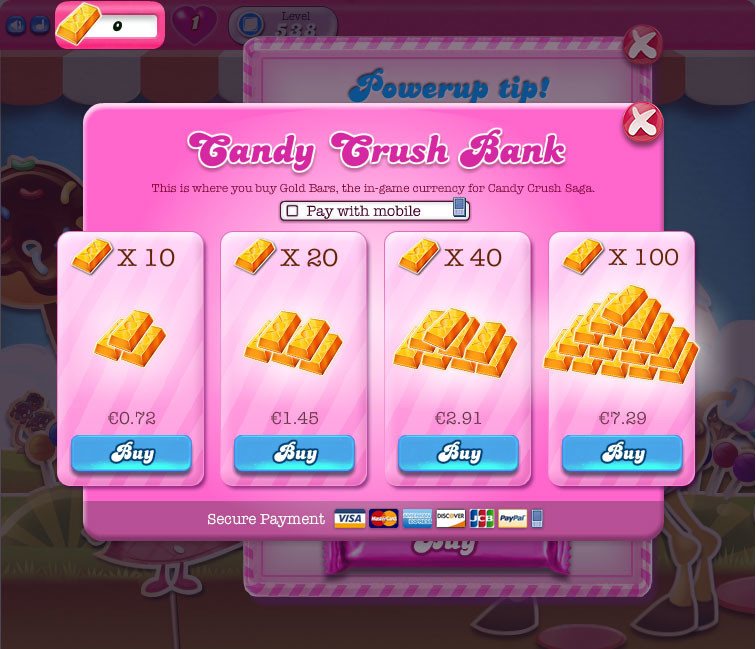
So the next time you're looking to pay to play Candy Crush Saga -- stop and think: who's really taking the candy from who?
Disclaimer: Thoughts are my own and do not represent any other parties.
Newsletter
I do this for the love of writing.
Each subscriber costs me money, but please do it anyway and spread the word. Monthly at most.