When building software costs almost nothing
Originally published on LinkedIn
We've heard of AI speeding up coding and 'agentic AI' being your new magic assistant. I wanted to draw your attention to the potential implications of these two trends.
To be specific -- what's happening?
(1) Software development cost is reducing -- the cost, effort, and skill required to develop useful software is rapidly reducing (at least for simple apps and scripts) thanks to generative AI (see: Replit, Lovable etc.) -- coined as "vibe coding."
(2) Agentic AI is becoming useful -- LLMs and AI agents have matured to the point where they're able to perform a series of autonomous actions to help achieve specific outcomes (see: OpenManus, 11x.ai, adoption of MCPs improving capability).
On (1) reducing software dev cost
This will benefit both builders and users...
- Easy prototyping for communication and experimentation -- it becomes much easier to build out prototypes for testing with your stakeholders and experimenting with ideas. You can now build a visual prototype of an app for your manager to show how you think a new feature should look and get buy-in.
- Expect a new range of niche apps -- "software for one" or boutique/bespoke software -- you know that one specific problem in your industry or field that only a few people in the world face? That's now more likely to be systematically solved by a niche app due to the lower build cost (alternatively you can try to build it yourself with AI-based coding tools) -- see the example of a lunchbox planning app built by Kevin Roose of the NYT.
This simultaneously increases the urgency for current software businesses to...
- Invest in a defensible moat -- if your software stack can be easily replicated, the years of investment poured into building it become vulnerable to competition. Your moat has to be around other dimensions of your business -- brand and relationships, unique data assets, vertical plays etc. (thought exercise: does Substack have a defensible moat?)
- Organise product dev effectively -- AI can develop (some) code faster than humans can test. Provided you can get your team to use AI well enough to realise this speed, the question to ask yourself is: "how much technical debt and brand risk are you willing to take on to outpace your competition?" There's an imperative to balance speed with originality, quality, and real customer impact.
On (2) useful agentic AI
It helps to understand how service models have evolved over time.
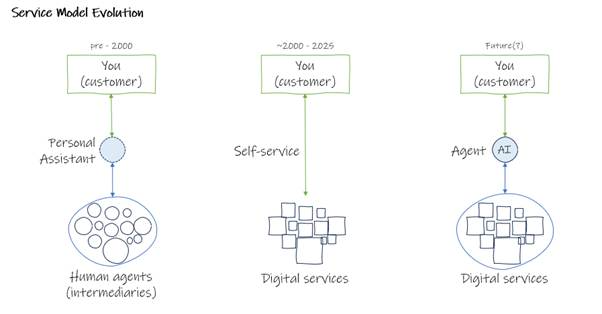
Let's say you wanted to organise a trip to Spain:
- (pre-2000s) Human intermediated -- you'd ring up a travel agent or personal assistant to book flights, rental cars, accommodation, and tours. Or you'd call each of those agencies yourself.
- (2000-2025) Digital services -- with the proliferation of the internet, you were able to book the same flights directly through websites -- Lufthansa, Booking.com, AVIS.
- (future) AI agents -- can now act like your personal assistant and interface directly with those digital services for you, automatically interfacing with airline and travel booking sites to book your trip on your behalf.
What are the implications?
One of the biggest shifts agentic AI introduces is a change in how businesses interface with customers -- or, more accurately, how they don't. If an AI agent can evaluate every possible service on a user's behalf, companies that once enjoyed direct user engagement may find themselves competing for visibility within an algorithmic selection process. We've seen this dynamic before with Google and Facebook, who used massive distribution advantages to relegate websites to "content providers" rather than end destinations. Here, the AI agent itself starts to function like a new aggregator, deciding which apps or services to invoke, leaving brands scrambling to stay relevant. (see: Ben Thompson's aggregation theory)
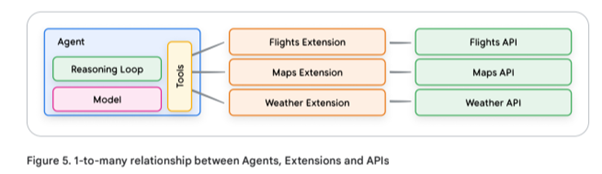
- End-to-end orchestration becomes more prevalent -- if agents are able to think and act on multi-step processes, then businesses who offer end-to-end delivery will stand to win. This creates an incentive to own your vertical (e.g. travel) -- we're already seeing moves in this space, as Google's 'Agents' whitepaper paints out below.
I do this for the love of writing — each subscriber costs me money. But please subscribe anyway and spread the word.
- User interfaces and UX matter far less vs. unique data sets and services -- in this potential future, customers may never need to actually see the Lufthansa website to book a flight, or Airbnb to find accommodation. An AI agent may automatically select and book those packages based on the customer's preferences. You'll win vs. your competition based on the quality of the data and service you're providing.
- Platforms that depend on user-generated content and direct engagement -- like Airbnb or TripAdvisor -- could see a significant drop in activity -- if users seldom visit these platforms to post reviews and feedback, it becomes far less likely that they'll generate the valuable crowdsourced data such services depend on for relevance.
- This may change buying behaviour and what brand loyalty means -- if agents can replicate 'set and forget' behaviours, then brand loyalty decisions may be deferred to AI agents. If your AI agent is automatically buying your groceries and clothing for you, do you still care as much about the brand if the product gets the job done?
It's still up in the air which kind of AI agent model might take over -- if it happens at all. We could end up with universal, super-personalised assistants (like Siri) that know pretty much everything about you, and/or specialised niche agents (like a TripAdvisor-type bot) that handle specific tasks brilliantly. In old-school terms, it's the difference between everyone having a single, super-talented personal assistant who does it all, versus people just knowing a handful of great agents for different needs -- like having a go-to travel agent for all your trips.
It's most likely that this will have an uneven impact across industries -- with digital-first, service-based players first in line for disruption. Alternatively, there exist scenarios where an ecosystem of modular agents plug into each other to get tasks done (agent marketplaces are already here).
So, how do you position your business in a world that could be dominated by AI agents?
Regardless of whether the leading agents end up being universal or specialised, the real prize appears to be the quality and uniqueness of your data. That's what you'll monetise, and it might not matter as much what your website or app looks like.
The critical move is making sure you've got (1) a solid moat of unique data, and (2) a strategy to keep capturing valuable data, even if users never visit your website.
The next question is: "Are you the aggregator agent... or are you a specialised provider in someone else's chain of agents?" -- the correct play is still unclear.
Other unanswered questions...
- Should you pivot your design thinking to designing for 'agents first' rather than human-first? Are your data schemas and APIs tailored for human consumption or AI consumption?
- How does trust and reputation work in an agent ecosystem? How is data accuracy verified? Do agents rate each other out of five for their service?
- If you believed in the super-agent scenario -- is it more likely that Google's typically open approach leads to Gemini being a more powerful agentic assistant than Apple's Siri? (Do we head into a future where device costs are subsidised by subscription fees for agents?)
Disclaimer: Thoughts are my own and do not represent any other parties.
Newsletter
I do this for the love of writing.
Each subscriber costs me money, but please do it anyway and spread the word. Monthly at most.
You might also like
The Six Simple Machines of AI
Every AI product in a business is a few of six simple machines bolted together. An assembly inherits every failure of every machine inside it.
AI shopping is years away. The infrastructure isn't.
When the AI does the buying, value migrates from attention to delegation. Stripe's five level map shows where commerce is today and what changes at Level 4.
The Codification Treadmill
The person who replaces you probably won't be AI. It'll be someone from the next department over who learned to use it.